
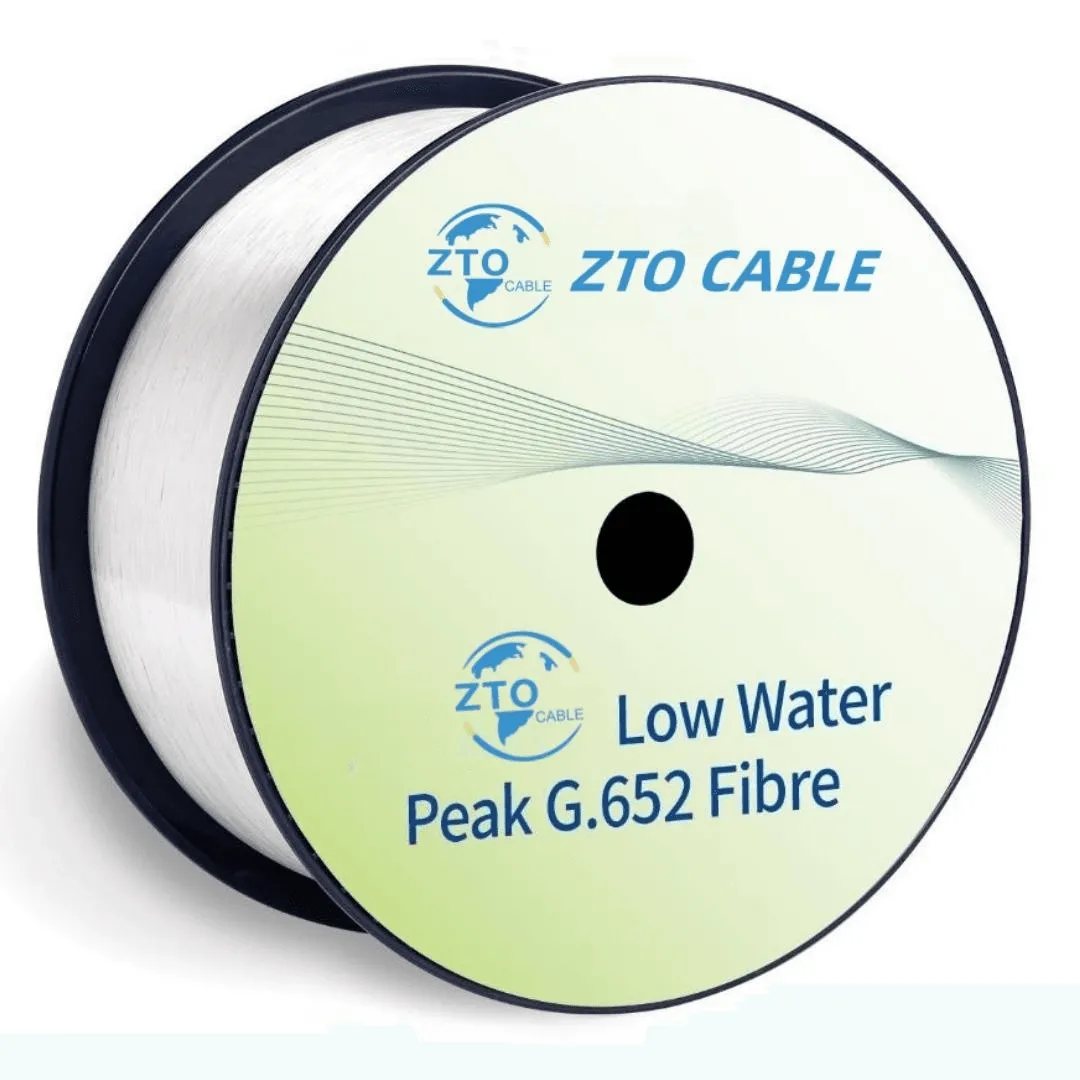
Optical Fiber
Bending Insensitive Single mode optical fiber G652 G652D
G.652.D is the industry-standard single-mode optical fiber — the most widely deployed fiber type worldwide, accounting for over 95% of all installed fiber. It features a zero water peak across the full spectrum from 1260nm to 1625nm, enabling CWDM and DWDM transmission across all wavelength bands. With low attenuation (≤ 0.22 dB/km at 1550nm) and low PMD (≤ 0.2 ps/√km), it supports transmission rates from 1G to 100G and beyond over distances exceeding 100km. Compliant with ITU-T G.652.D and IEC 60793-2-50 standards.
Get the Best PriceZTOFC low water peak dispersion unshifted single-mode fiber is designed for optical transmission systems operating over the entire wavelength window from 1260nm to 1625nm. By suppressing the water peak that occurs near 1383nm in conventional single-mode fiber due to hydroxyl (OH⁻) ions absorption, ZTOFC fiber opens the E-band (1360–1460nm) for operation, providing 100nm more usable wavelengths.
Specifications
Optical Characteristics
| Characteristics | Conditions | Specified values | Units |
| Attenuation | 1310nm | ≤0.34 | [dB/km] |
| Attenuation | 1383nm(after H2-aging) | ≤0.34 | [dB/km] |
| Attenuation | 1550nm | ≤0.20 | [dB/km] |
| Attenuation | 1625nm | ≤0.24 | [dB/km] |
| Attenuation vs. WavelengthMax. α difference | 1285-1330nm, in reference to 1310nm | ≤0.03 | [dB/km] |
| Attenuation vs. WavelengthMax. α difference | 1525-1575nm, in reference to 1550nm | ≤0.02 | [dB/km] |
| Dispersion Coefficient | 1285-1340nm | -3.5 to 3.5 | [ps/(nm·km)] |
| Dispersion Coefficient | 1550nm | ≤18 | [ps/(nm·km)] |
| Dispersion Coefficient | 1625nm | ≤22 | [ps/(nm·km)] |
| Zero Dispersion Wavelength(λ0) | — | 1300-1324 | [nm] |
| Zero Dispersion Slope(S0) | — | ≤0.092 | [ps/(nm2·km)] |
| Typical Value | — | 0.086 | [ps/(nm2·km] |
| PMD / Maximum Individual Fibre | — | ≤0.1 | [ps/√km] |
| PMD / Link Design Value(M=20,Q=0.01%) | — | ≤0.06 | [ps/√km] |
| PMD / Typical Value | — | 0.04 | [ps/√km] |
| Cable Cutoff Wavelength (λCC) | — | ≤1260 | [nm] |
| Mode Field Diameter(MFD) | 1310nm | 8.7-9.5 | [μm] |
| Mode Field Diameter(MFD) | 1550nm | 9.8-10.8 | [μm] |
| Effective Group Index of Refraction(Neff ) | 1310nm | 1.466 | — |
| Effective Group Index of Refraction(Neff ) | 1550nm | 1.467 | — |
| Point Discontinuities | 1310nm | ≤0.05 | [dB] |
| Point Discontinuities | 1550nm | ≤0.05 | [dB] |
Geometrical Characteristics
| Characteristics | Specified values | Units |
| Cladding Diameter | 125.0±0.7 | [μm] |
| Cladding Non-Circularity | ≤1.0 | [%] |
| Coating Diameter | 235-250 | [μm] |
| Coating-Cladding Concentricity Error | ≤12.0 | [μm] |
| Coating Non-Circularity | ≤6.0 | [%] |
| Core-Cladding Concentricity Error | ≤0.6 | [μm] |
| Curl(radius) | ≥4 | [m] |
| Delivery Length | Up to 50.4 | [km/reel] |
Environmental Characteristics ( 1310nm, 1550nm & 1625nm )
| Characteristics | Conditions | Specified values | Units |
| Temperature Dependence Induced Attenuation | -60℃ to +85℃ | ≤0.05 | [dB/km] |
| Temperature-Humidity Cycling Induced Attenuation | -10°C to +85°C, 98% RH | ≤0.05 | [dB/km] |
| Watersoak Dependence Induced Attenuation | 23°C, for 30 days | ≤0.05 | [dB/km] |
| Damp Heat Dependence Induced Attenuation | 85°C and 85% RH, for 30 days | ≤0.05 | [dB/km] |
| Dry Heat Aging | 85℃, for 30 days | ≤0.05 | [dB/km] |
Mechanical Specification
| Characteristics | Conditions | Specified values | Units |
| Proof Test | — | ≥9.0 | [N] |
| Proof Test | — | ≥1.0 | [%] |
| Proof Test | — | ≥100 | [kpsi] |
| Macro-bend Induced Attenuation | |||
| 100 Turns Around a Mandrel of 30 mm Radius | 1625nm | ≤0.05 | [dB] |
| 100 Turns Around a Mandrel of 25 mm Radius | Radius1310nm and 1550nm | ≤0.05 | [dB] |
| 1 Turn Around a Mandrel of 16 mm Radius | 1550nm | ≤0.05 | [dB] |
| Coating Strip Force | typical average force | 1.5 | [N] |
| Coating Strip Force | peak force | 1.3-8.9 | [N] |
| Dynamic Fatigue Parameter(nd) | — | ≥20 | — |
Applications
- Supports Ethernet, IP, ATM, SONET/SDH, and WDM transmission systems
- Backbone, metropolitan area, and access networks
- CWDM and DWDM systems utilizing full 1260–1625nm spectrum
- High-speed transmission technologies requiring low PMD and low attenuation
Characteristics
- Designed for operation over the full optical spectrum from 1260–1625nm, providing 50% more usable wavelengths and increased transmission capacity
- Outstanding optical performance supporting high-speed transmission technologies such as DWDM and CWDM
- Compatible with existing 1310nm equipment
- Good protection and excellent strip force stability
- Accurate geometrical parameters ensure low splicing loss and high splicing efficiency
Standard
- ITU-T G.652.D
- IEC 60793-2-50 type B1.3
- Parameters tightened beyond standard specifications for customer convenience
Key Features
- Zero water peak: full-spectrum operation from 1260nm to 1625nm
- Attenuation ≤ 0.22 dB/km @ 1550nm (premium grade available ≤ 0.19 dB/km)
- Low PMD ≤ 0.2 ps/√km — supports 40G and 100G transmission
- CWDM and DWDM ready — all 18 CWDM channels available
- Industry-standard 125μm cladding, 245μm coating diameter
- Compliant with ITU-T G.652.D, IEC 60793-2-50, Telcordia GR-20
Frequently Asked Questions
1. What makes G.652.D different from G.652.A/B?
The key difference is the water peak. G.652.A and B have a hydroxyl (OH⁻) absorption peak around 1383nm, blocking the E-band. G.652.D eliminates this peak, opening the full 1260–1625nm spectrum for CWDM/DWDM transmission. G.652.D also has lower PMD (0.2 vs 0.5 ps/√km), critical for high-speed transmission.
2. What fiber count and length options are available?
G.652.D fiber is supplied on standard reels of 25.2km, 50.4km, or custom lengths. It is incorporated into our cable products in fiber counts ranging from 2 to 288. Contact us for volume pricing and specification sheets.
3. Is G.652.D suitable for 5G fronthaul networks?
Yes. G.652.D remains the recommended fiber for 5G fronthaul, midhaul, and backhaul applications. It supports 25G and 50G eCPRI links over distances up to 10–20km, which covers the vast majority of 5G deployment scenarios.
Hot Products
Contact us now for discounts
Get the best price for your fiber optic cable order