
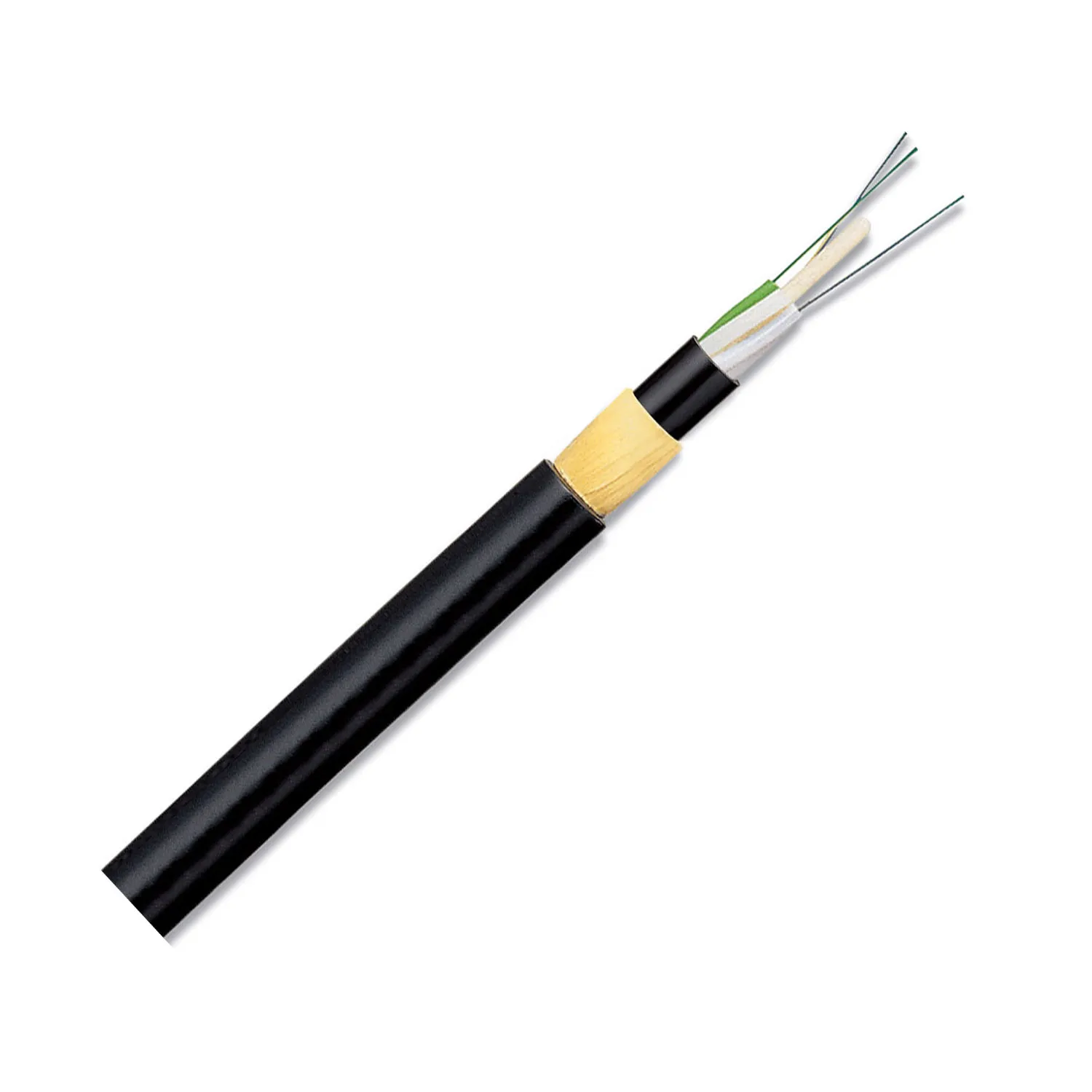
ADSS optical cable: the aerial highway of power communication, a worry-free and tough choice
ADSS optical cable: the aerial highway of power communication, a worry-free and tough choice
Published: 2025-06-27
What Is ADSS Fiber Optic Cable?
ADSS (All-Dielectric Self-Supporting) fiber optic cable is a specialized aerial cable designed for installation on high-voltage power transmission and distribution lines. Unlike traditional aerial fiber cables that require a separate steel messenger wire for support, ADSS cable hangs directly between poles or towers using its own internal strength members.
The “All-Dielectric” advantage: ADSS contains zero metal — no steel strength members, no aluminum armor, no copper conductors. This is the critical property that makes it safe to install on live power lines: there is no conductive path for electricity, no ground loops to manage, and no risk of a cable fault causing a phase-to-ground short circuit on the power line.
How ADSS Cable Is Constructed
ADSS cable is built around a load-bearing non-metallic core:
- Optical fibers (250µm) are placed in loose tubes made of high-modulus plastic, filled with water-blocking gel
- Loose tubes are stranded around a FRP (Fiber Reinforced Plastic) central strength member
- The cable core is covered with a thin PE inner sheath
- A layer of aramid yarns (Kevlar-like fibers) is stranded over the inner sheath — these are the primary tensile strength members
- An outer sheath of PE (for ≤110kV lines) or AT anti-tracking material (for ≥110kV lines) completes the cable
Key Advantages of ADSS
1. Live-Line Installation
ADSS can be installed on energized power lines without shutting off power. This eliminates outage coordination, reduces project timelines, and avoids revenue losses for the utility during construction.
2. No Messenger Wire Required
The aramid yarn strength members integrated into the cable eliminate the need for a separate steel messenger wire, reducing wind/ice loading on towers and simplifying installation hardware requirements.
3. Complete EMI Immunity
The all-dielectric construction provides total electromagnetic interference (EMI) immunity — no ground loops, no induced currents from power lines, and no lightning conduction risk through the fiber.
4. Long Span Capability
Double-jacket ADSS supports spans up to 1500m, making it suitable for crossing wide rivers, valleys, and highways where intermediate poles cannot be placed.
5. 30-Year Design Life
Manufactured to IEEE P1222 and IEC 60794-1 standards, ADSS is rated for a 30-year outdoor service life with stable optical and mechanical performance across temperature extremes (-40°C to +70°C).
ADSS Span Capacity Guide
| Span Range | Cable Type | Typical Application | Voltage Range |
|---|---|---|---|
| 50 – 150 m | Single jacket ADSS | Distribution poles, short spans | 10 – 35 kV |
| 150 – 200 m | Single jacket (reinforced) | Medium distribution spans | 10 – 35 kV |
| 200 – 500 m | Double jacket ADSS | Transmission towers, standard spans | 35 – 220 kV |
| 500 – 1000 m | Double jacket (heavy-duty) | Long transmission spans, moderate terrain | 110 – 220 kV |
| 1000 – 1500 m | Double jacket (max span) | River/valley crossings, extreme spans | 110 – 220 kV |
Single Jacket vs Double Jacket: How to Choose
Single Jacket ADSS: One PE layer over aramid yarn directly on the cable core. Lighter weight, lower cost. Ideal for distribution-level applications (10-35kV) with spans under 200m.
Double Jacket ADSS: Inner PE sheath + aramid yarn layer + outer PE/AT sheath. Higher tensile strength, better environmental protection, AT (anti-tracking) outer sheath option. Required for transmission lines (≥110kV) and spans over 200m.
Voltage Compatibility and AT Sheath
A critical consideration for ADSS is the electrical field at the cable’s position on the tower. The cable must be positioned where the space potential gradient does not exceed the sheath’s tracking resistance:
- PE outer sheath: Suitable for space potentials up to 12kV (typical for ≤110kV lines)
- AT (Anti-Tracking) outer sheath: Suitable for space potentials up to 25kV (required for ≥110kV lines)
Incorrect positioning or voltage rating can cause dry-band arcing and tracking degradation of the outer sheath over time. Properly specified ADSS with AT sheath avoids this failure mode entirely.
Standards Compliance
ZTOFC ADSS cables are manufactured and tested to:
- IEEE P1222 — Standard for all-dielectric self-supporting fiber optic cable for use on overhead utility lines
- IEC 60794-1 — Optical fibre cables: Generic specification
- IEC 60794-3-20 — Family specification for self-supporting aerial telecommunication cables
- DLT 788-2016 — Chinese electric power industry standard for ADSS
Related Products
Frequently Asked Questions
1. What is ADSS fiber optic cable?
ADSS stands for All-Dielectric Self-Supporting. It is a fiber optic cable designed for aerial installation on power transmission and distribution lines without requiring a separate messenger (support) wire. The 'all-dielectric' construction means it contains no metallic components, making it electrically safe to install on energized (live) power lines without shutting off power.
2. What voltage levels can ADSS cable be installed on?
Standard PE-sheath ADSS is suitable for lines up to 110kV. For lines rated 110kV and above, AT (anti-tracking) sheath ADSS is required to withstand the higher electrical field strength on the cable surface. AT sheath can operate at an induced voltage of up to 25kV at the cable surface without degradation.
3. What is the maximum span distance for ADSS?
Single jacket ADSS supports spans from 50m to 200m (ideal for distribution lines 10-35kV). Double jacket ADSS supports spans from 200m to 1500m (transmission lines, river/valley crossings). The actual achievable span depends on tower spacing, ice/wind loading conditions, and the cable's rated tensile strength.
4. Does ADSS cable require shutting off power during installation?
No — this is one of ADSS's key advantages. It can be installed on live (energized) power lines without requiring an outage, significantly reducing operational disruption, revenue loss, and project coordination complexity compared to OPGW which requires a line shutdown for installation.